3D models
This page describes the CAD files (3D models) for the electron gun, which you will need to 3D print in order to build the electron gun.
Introduction
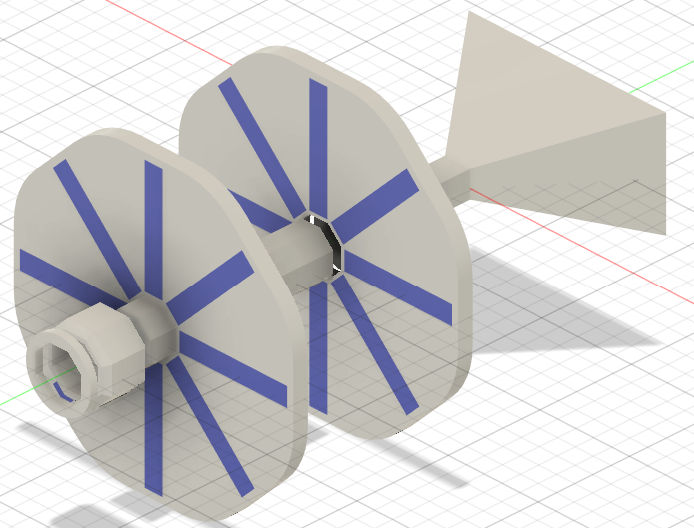
The main electron gun CAD model (pictured above) is in the STEP format. This format’s main purpose is to allow for cross-platform support for accessing the CAD file through different CAD software.
- If you have a CAD software installed: For most CAD software the steps for importing a file include navigating to file then finding the import button and finding the downloaded file in the computer to import.
- If you do not have a CAD software installed: Another way the software can be be opened without CAD software is through an online viewer. We recommend the eMachineShop Online Viewer for this purpose.
This folder also contains BREP files of the same model. BREP files are used to store 3D models using a boundary representation method, which defines a shape by its enclosed boundaries. This makes it more suitable for use in finite-element simulations.
CAD files
The CAD files for the electron gun are all in the Model Drafts folder in the laser repository. They come in several different formats and are listed in the following table:
| File | Description |
|---|---|
Elara Electron Gun Assembly v6.step |
CAD model of electron gun (in process of being updated) |
Elara Electron Gun Assembly BREP v2.brep |
Same model as above, but exported to BREP format (optimized for finite element simulations, generally should not be edited) |
Solenoid-Torus-ElectronGun-ProjectElara.step |
CAD model of a torus-shaped magnetic lens for the electron gun (now outdated) |
Solenoid-Torus-ElectronGun-ProjectElara.3mf |
Same model as above, but exported to 3MF format (now outdated) |
Solenoid-With-Holes-ElectronGun-ProjectElara-no-tolerance.step |
CAD model of a slottable magnetic lens for the electron gun |
Solenoid-With-Holes-ElectronGun-ProjectElara-no-tolerance.stl |
Same model as above, but exported to STL format (used for 3D printing) |
Technical notes
A normal electron gun is a electrical component that produces an electron beam at a specific energy. We couldn't use the more efficient thermocathode because it introduces additional thermal heat considerations. For reference, an example of an electron gun in everyday use is in older televisions that used cathode ray tubes as the way to generate the images on the screen. Temperatures in a thermocathode can reach thousands of degrees Celsius, making it difficult to work with.
The electron gun uses electrostatic acceleration to accelerate electrons to high speed, then goes into the undulator where it is turned into microwaves. Light (UV) will be used to create the electrons, so a UV-C lamp will be placed in the frame of the electron gun. The light enters a reflective chamber where the chamber is electroplated in aluminum, then at the end of the chamber is a small tin photocathode.
Beyond the electron gun CAD model, there will be dedicated turning magnets which are essentially just modified horseshoe magnets, and it uses two flat magnets of opposite polarities (south pole of one magnet faces the north pole of the other magnet).