Basics
This page goes over the basics of what you should know before developing (or building) Project Elara's laser.
What is a free-electron laser?
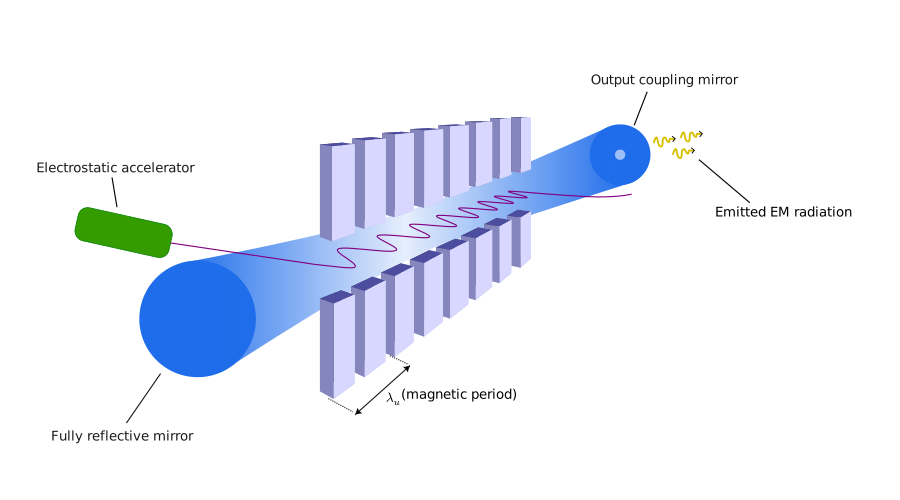
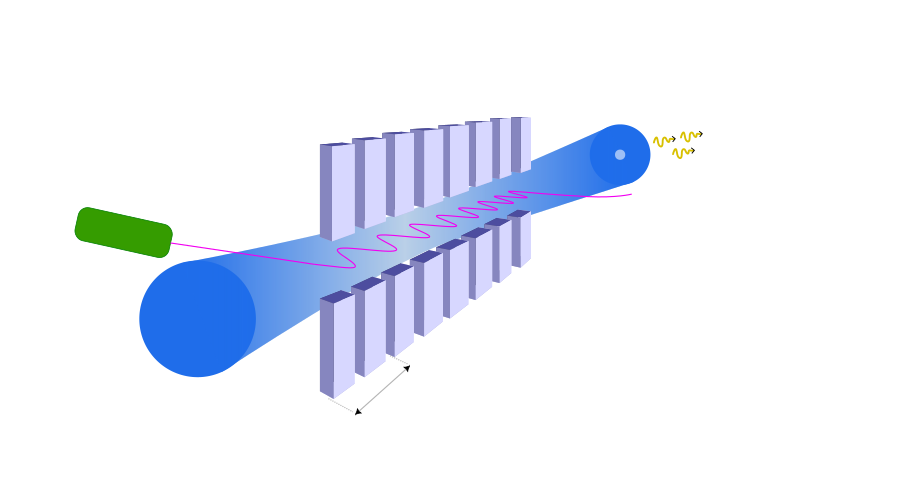
A free-electron laser is a highly-specialized type of laser that extracts energy from an electron beam and radiates that energy in the form of electromagnetic radiation (light). Free-electron lasers can operate across the entire electromagnetic spectrum, producing everything from X-rays and UV light to visible light, infrared light, and microwaves. They work by accelerating electrons to close to the speed of light and then injecting them into an alternating magnetic field. This magnetic field causes the electrons to emit electromagnetic waves, which then form into a laser beam.
Why do we need a free-electron laser?
At Project Elara, our ultimate goal is to build a robust system from beaming solar power collected in space down to Earth. Transmitting power over the immense distances from space to Earth requires powerful lasers; however, Earth's atmosphere blocks most visible and near-infrared lasers. Microwave lasers (masers) have long been sought after as an alternative. Free-electron masers have little to no moving parts, naturally operate in vacuum (making them well-suited to space environments), and can generate very powerful beams. In addition, unlike traditional laser diodes and other solid-state lasers, they do not require crystals or semiconductors and therefore do not need the specialized assembly lines and expensive manufacturing equipment. Hence, we believe that free-electron lasers (masers) are the best choice for making an open-source laser that is feasible for a small team to design and build.
Our laser design
Our laser is a free-electron laser that is designed to operate in the microwave regime. It is split into several components as is standard for a free-electron laser design, including an electron gun and undulator.
The name of our prototype laser is Faraday One, named after the great physicist and scientist Michael Faraday, and chosen by the Elara community. We chose this name because Faraday reflects our highest ideals, in his many contributions to science, his extensive record of public service, his interest in sharing his knowledge openly, and his deep humility and principled character.
Open-source
Project Elara is committed to making all of its work open-source, and that includes this laser. The laser hardware and software is available in Project Elara's laser research repository. This documentation site is developed in the separate but related laser docs repository.
You are welcome to freely browse through the laser's source code and source files, customize the laser design to your needs, remix it, share it, and even sell it if you so wish. We hope that if you find our work useful, you can contribute back to us.