Electron Gun Information
This page contains information about the electron gun, a crucial component in the free-electron laser.
How do electron guns work?
The general purpose of an electron gun is to create a beam of electrons, which is needed by a free-electron laser. An electron gun must perform several major functions:
- Strip away electrons from a material to produce free electrons (i.e. electrons that aren't bound to atoms)
- Accelerate the electrons to very fast speeds. This part is often a separate component and called a linear accelerator (or linac for short), and uses either radio waves (RF linac) or an electrostatic field (DC linac) for acceleration.
- Focus the electrons into a beam, which is often done with magnets using a specialized device known as a magnetic lens
Electron guns have a negatively-charged cathode and a positively-charged anode. Since electrons are negatively-charged particles, they are repulsed by the cathode and attracted towards the anode. The cathode and anode have a potential difference (voltage) between them which accelerates the electrons via the Lorentz force. There are generally three (main) types of electron guns (as well as some special varieties and hybrid variants):
- Photocathode electron guns (the one we use)
- Thermionic electron guns
- Cold emission electron guns
Note
All electron guns need to be kept in a vacuum environment, typically high vacuum or ultra-high vacuum. This means that the air pressure inside of an electron gun is under a millionth of atmospheric pressure (and sometimes under a quadrillionth of atmospheric pressure!) In vacuum conditions, there are very few air molecules to impede the flow of electrons, allowing an electrons to travel in (nearly) straight lines and form a beam.
Photocathode electron gun
A photocathode electron gun is the design that is currently used in Elara's laser. It works like this:
- Photons from a light source (usually a UV light source) hit a metal or semiconductor. This is called the photocathode
- The photons eject electrons from the surface of the metal via the photoelectric effect
- The electrons are pulled towards a positively-charged anode
Info
A photocathode electron gun that uses a laser as the light source and an RF (radio-frequency AC) linac is known as photoinjector and is used in specialized particle accelerator facilities. However, we've chosen to go with an electrostatic design with a UV lamp as a light source, which is much simpler to design and build.
Thermionic electron gun
A thermionic electron gun works like this:
- A filament of tungsten or a piece of barium oxide (or a material with similar properties) is heated by a current until it has enough energy for the electrons to escape. This usually takes place at temperatures of over 1000 K (>726 degrees Celsius)
- A voltage is applied to an anode, which is put after the cathode creating a strong electric field that pulls negatively charged electrons towards the anode.
- Between the cathode and anode a negatively charged control electrode (Wehnelt Cylinder) is used. It adjusts the voltage to either attract or repel the electrons. This controls the number of electrons going through the anode and therefore the intensity.
- The electrons pass through a hole in the anode and continue as a beam. The container this system is in is evacuated which means it is a vacuum within.
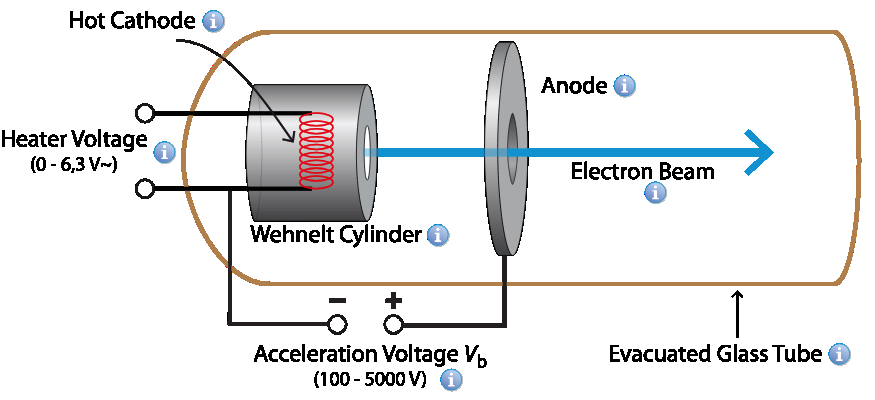
Diagram of a thermionic electron gun. Original source: Physics SE
Cold emission electron gun
A cold emission electron gun uses an intense electric field to "pull" electrons from a sharp metal tip. This occurs due to quantum tunneling leading to a phenomenon called field emission. It is called cold emission since it occurs at room temperature, rather than at the high temperatures of "hot" (thermionic) cathodes. However, it requires that the cathode be sharpened into a very thin (~100 nm) tip and thus requires specialized equipment (which we do not have) to make.
Hybrid designs
A combination of thermionic, photocathode, and cold emission designs is also possible, although these designs are generally purely experimental at this point.
How the electron gun and undulator fit together:
The undulator comes after the electron gun. It converts the straight beam of electrons to microwaves (in our project).